 Image:
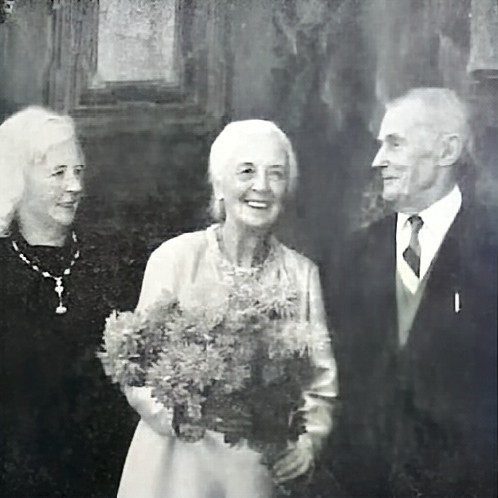
 Friedrich Pfister on 9 November 1966 at the 80th birthday of Mrs. Clara Burger, daughter of the Heidelberg archaeologist Geheimrat von Duhn; beside her, his granddaughter Dr. Lili Fehrle, née Burger — private photograph
Shortly before completing his eighty-fifth year, Friedrich Pfister died in Würzburg as professor emeritus of classical philology. With his death on 27 December 1967, the University of Würzburg lost one of its most distinguished and original scholars. His scholarly achievements lie chiefly in the application of his classical linguistic training to comparative religious studies and folklore. At the center of his interests - and bound up, in a peculiarly fascinating way, with the fate of this well-traveled and perceptive
philologist's own eventful life - stood, from his youth onward, the legend-shrouded figure of Alexander
the Great. With critical acuity, Pfister worked tirelessly to distinguish, within the myth-making of world literature surrounding this conqueror — who was venerated even in his own lifetime as a sun-like demigod — between later poetic embellishment, contemporary veneration, and historical truth. A good sense of the far-reaching problems of this life's work, which remained unfinished, is offered by Pfister's 1956 study „Alexander der Große in den Offenbarungen der Griechen, Juden, Mohammedaner und Christen", published by the German Academy of Sciences in Berlin. This lucid summary conveys the inner richness of the Alexander myth, which is so multifaceted and profound that a single human life — even one possessed of the greatest scholarly diligence — could scarcely suffice to exhaust the subject.
Yet Pfister's scholarly achievements were by no means confined to this circle of themes. In the study of the ancient roots of traditional annual festivals and folk customs — particularly in the field of Palatine folklore — he stood as one of the foremost German scholars of antiquity, maintaining a constant and fruitful exchange of ideas with his closest colleague in the field, Eugen Fehrle, professor of folklore at Heidelberg. One encounters the names of these two former fellow students from Heidelberg at every turn across the most varied areas of German folklore studies — including the reference work founded by Hoffmann-Krayer and Bächtold-Stäubli in 1927, whose nine substantial volumes, published under the all-too-modest title „Handbuch des deutschen Aberglaubens", have since become the indispensable tool of a young and much-consulted discipline that has, unfortunately, once again fallen into neglect at today's universities. Nonetheless, this exemplary handbook retains its unmistakable place in public libraries — including at Heidelberg University, which, as folklore studies' onetime illustrious founding institution, now seems scarcely inclined to recall the brilliant flowering of spirit that marked the age of Romanticism there. Anyone who leafs through this reference work, however, will repeatedly come across the name Pfister among its most active contributors, wherever the task is to illuminate the puzzling obscurity of German folk belief through persuasive explanations of the primal peculiarities of its world of fairy tales — whether by pointing to far-reaching influences from early myth-formation, or by drawing comparisons with related traits in the ancient folk beliefs of Indo-European Mediterranean peoples. The university prize essay set by his teacher Albrecht Dieterich — with which Pfister's academic career, already in 1905, during his Heidelberg student years, achieved a sensational success — appeared in 1909 in the fifth volume of the „Religionsgeschichtliche Versuche" under the title „Der Reliquienkult im Altertum", a study widely noted in scholarly circles. A taut discipline in the construction of argument, joined to an innate gift for the
logically compelling clarity of carefully considered formulations, and a classically polished style — one this literarily gifted scholar of antiquity had already practiced in a number of publications since his final years at school — emerge here as characteristic virtues of the young author. The industrious diligence with which he went on to pursue his scholarly publications, in the form of books and an almost uncountable wealth of contributions to journals and newspapers, with a particular fondness for Palatine folklore, is overwhelmingly attested by the impressive number of 600 opera and opuscula.
Image:
Meeting this slight, charming scholar in person — a man who regaled company with humorous anecdotes, and whom his Italian colleagues liked to call "il gentile Pfister" — one would hardly have suspected, behind such amiable good cheer, the demonic drive for knowledge that animated this profound Alexander scholar. That side of him only occasionally came to light, in lively verbal sparring matches, when he knew how to corner his conversation partner, quite defenseless, with piquant samples of logical acuity and quick wit — though never in a way that humbled or wounded them, for his chivalrous generosity would not allow him to enjoy his triumphs at a defeated opponent's expense. Wherever he appeared, with his slender, striking scholar's head and fine, sensitive features, people felt a spontaneous fondness for him. Through this widespread popularity he also won much goodwill for his homeland, for beneath all the elegance of his self-assured, worldly manner one
always sensed as well the simple warmth of a man who was, body and soul, a Palatine.
He was born on 6 January 1883 in Kaiserslautern, the son of the Bavarian district court councillor (Landgerichtsrat) Bernhard Pfister. His somewhat melancholic father, who died young, came from a Catholic teaching family in Lower Franconia, while his capable mother — a cheerful native of the Rhenish Palatinate — had grown up in Kaiserslautern as the daughter of the well-to-do Protestant Karsch family, whose family tree could be traced back to the turbulent age of the Palatine princess Liselotte. Her father owned a powder mill above the town on the Rittersberg, and it was there that little Friedrich's earliest memories, from his first seven years, took shape, before he moved with his parents and siblings to Baden-Baden, where he attended the humanistic Gymnasium and passed his Abitur. Shortly after the turn of the century his eventful student years in Heidelberg began, interrupted only twice by stimulating semesters in Munich and Berlin. After extensive study trips through Greece, Asia Minor, and Rome under the guidance of his teacher — the Heidelberg archaeologist Friedrich von Duhn - he began his teaching career in 1912 as a Privatdozent in Heidelberg, continuing in Marburg until he was called up for military service. After the end of the First World War he received a teaching appointment as an associate professor (Extraordinarius) in Tübingen. At his mother's home - she had already moved to Heidelberg during his student years - he soon afterward met, in the summer of 1919, Irmgard Suadicani of Lübeck. She was studying philosophy and German literature. In her he found an ideal life companion, and they married that same year. In 1924 he was appointed full professor (Ordinarius) in Würzburg, where, alongside
intensive scholarly work, he enjoyed a happy family life. But in his heart - even on the extensive study trips he often undertook from there - he always remained a Palatine.
Overview of the most important works:
Wanderung durch die Pfalz. Beilage zur „Pfälzer Presse" 1898 (Publikation des fünfzehnjährigen Gymnasiasten).
Die mythische Königsliste von Megara 1907.
Der Reliquienkult im Altertum I 1909, II 1912.
Kleine Texte zum Alexanderroman. Heidelberg 1910.
Der Alexanderroman des Archipresbyters Leo. Heidelberg 1913.
Eine jüdische Gründungsgeschichte Alexandrias 1914.
Anhang über Alexanders Besuch in Jerusalem 1914 (Sitzungsberichte der Heidelberger Akademie der Wissenschaften).
Schwäbische Volksbräuche, Feste und Sagen. Augsburg 1924.
Der Wahnsinn des Weihepriesters. Cimbria 1926.
Vademecum für den klassischen Philologen. Leipzig 1933.
Deutsches Volkstum im Glauben und Aberglauben. Deutsches Volkstum Band 4, Berlin und Leipzig 1936.
Einführung in die Philosophie des Altertums. Würzburg 1948.
Sprache und Schrifttum der Griechen im Rahmen der Altertumswissenschaft. Freiburg i. Br. 1944.
Zeittafel für das klassische Altertum und seine Erforschung. Würzburg 1947.
Die Reisebilder des Herakleides. Wien 1951.
Götter- und Heldensagen der Griechen. Heidelberg 1956.
Alexander der Große in den Offenbarungen der Griechen, Juden, Mohammedaner und Christen. Berlin 1956.